BI Meets AI: What We Showed Parking Professionals About the Future of Parking Analytics

We recently hosted an NPA Tech Talk called “BI Meets AI: Smarter Parking, Faster Decisions.” We were joined by Juan Soto, Executive Director of Parking & Mobility for the Intuit Dome and Kia Forum, and Andrew Sachs, President of Gateway Parking Services and co-creator of Parkonomics.
The session was part education, part demo, part honest conversation about what AI can and cannot do for parking operations today. We walked through a five-level framework for parking business intelligence, showed where AI fits at each level, and demoed capabilities we have been building into the next generation of JustPark Insights (in beta now).
This post recaps that framework and introduces what we have built.
First Things First: Your Data Has to Be in One Place
Before we talked about AI, we talked about data. The parking industry runs on dozens of systems. PARCS, mobile pay, meters, pay stations, sensors, LPR, enforcement, reservations, ticketing and more. Most operators have data spread across three or more vendors, each with its own portal, its own export format, and its own version of the truth.
You can’t harness the full power of AI (or traditional BI for that matter) if your data is fragmented. Neither can traditional BI. The foundation of everything we showed in the webinar is data consolidation: connecting every system into a single, normalized view of how your facilities are actually performing.
That is what JustPark Insights has done for over a decade. We started as Smarking in 2014, became the first company to bring consolidated business intelligence to parking, and today connect to more than 65 integration partners across PARCS, payment apps, meters, pay stations, sensors, and LPR. We serve over 2,500 parking locations across North America and the UK, working with commercial real estate owners, municipalities, universities, airports, and parking operators of every size.
Five Levels of Parking BI
In the webinar, we introduced a framework for thinking about what parking analytics can do. Five levels, from basic to advanced, with AI playing an increasingly significant role as you move up.
Level 1: Descriptive: “What happened (or is happening right now)?”
This is the foundation. Charts, dashboards, KPIs. How much revenue did we make last week? What was occupancy on Saturday? What is occupancy across my city blocks and garages right now?
Descriptive BI is table stakes. Without it, you are pulling reports from vendor portals one at a time, pasting numbers into spreadsheets, and making decisions on data that is days or weeks old. With it, you have a single live view of every location. You should be able to answer any question, about any of your locations across all of your data systems, in seconds.
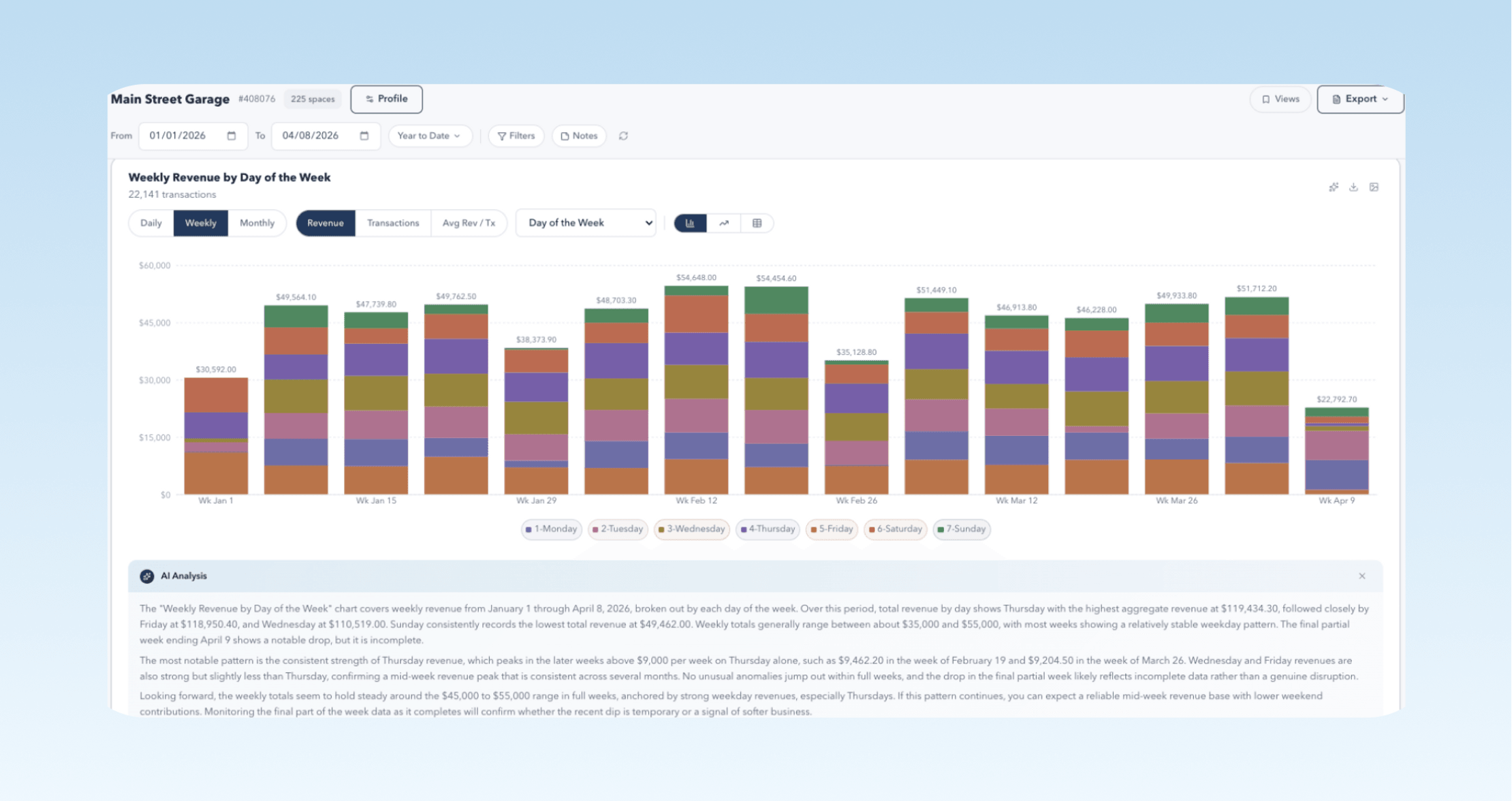
Where AI helps today: AI is genuinely good at descriptive analysis. Every chart in JustPark Insights now has an AI button. Click it, and the AI already has full context: the data on screen, the date range, the filters, the location. It identifies patterns, calls out what is notable, and summarizes what you are looking at. One click and you have a second pair of expert analytical eyes on any chart.
Beyond individual charts, a global AI Assistant is accessible from anywhere in the tool. Ask it anything in plain English. “What was our busiest day last week?” “How did revenue compare across my downtown locations?” It pulls the data, runs the analysis, and gives you an answer in seconds.
Level 2: Diagnostic: “Why did it happen?”
This is where many parking data teams spend their time. Revenue dropped on Tuesday. Why? Was it weather? A broken gate? A rate change? A competing event that pulled traffic elsewhere?
Diagnostic analysis has traditionally been manual and time-consuming. You look at the data, form a hypothesis, pull more data, cross-reference with what your team knows, and eventually piece together an explanation.
Where AI helps today: AI is good at diagnostic parking BI. It can cross-reference multiple data streams, identify correlations, and surface plausible explanations faster than any person could. In JustPark Insights, the AI Assistant handles diagnostic questions naturally. “Why did Garage 3 underperform last Tuesday?” It checks revenue, transactions, occupancy, duration patterns, and compares against historical norms.
But we were honest in the webinar about the watch-outs. AI can be overconfident. It doesn’t say “I don’t know” easily. It can be sycophantic, telling you what you want to hear. And it is context-blind. It does not know that Monday was a holiday, Gate 3 was down for maintenance, or your best attendant called in sick.
Within JustPark Insights, we have created mitigants for all these watch-outs so that the AI is objective, transparent, and focused.
Level 3: Predictive: “What’s going to happen?”
This is where analytics starts looking forward. Forecasting occupancy, transactions, and revenue. Projecting demand so you can plan staffing, pricing, and overflow before the day arrives.
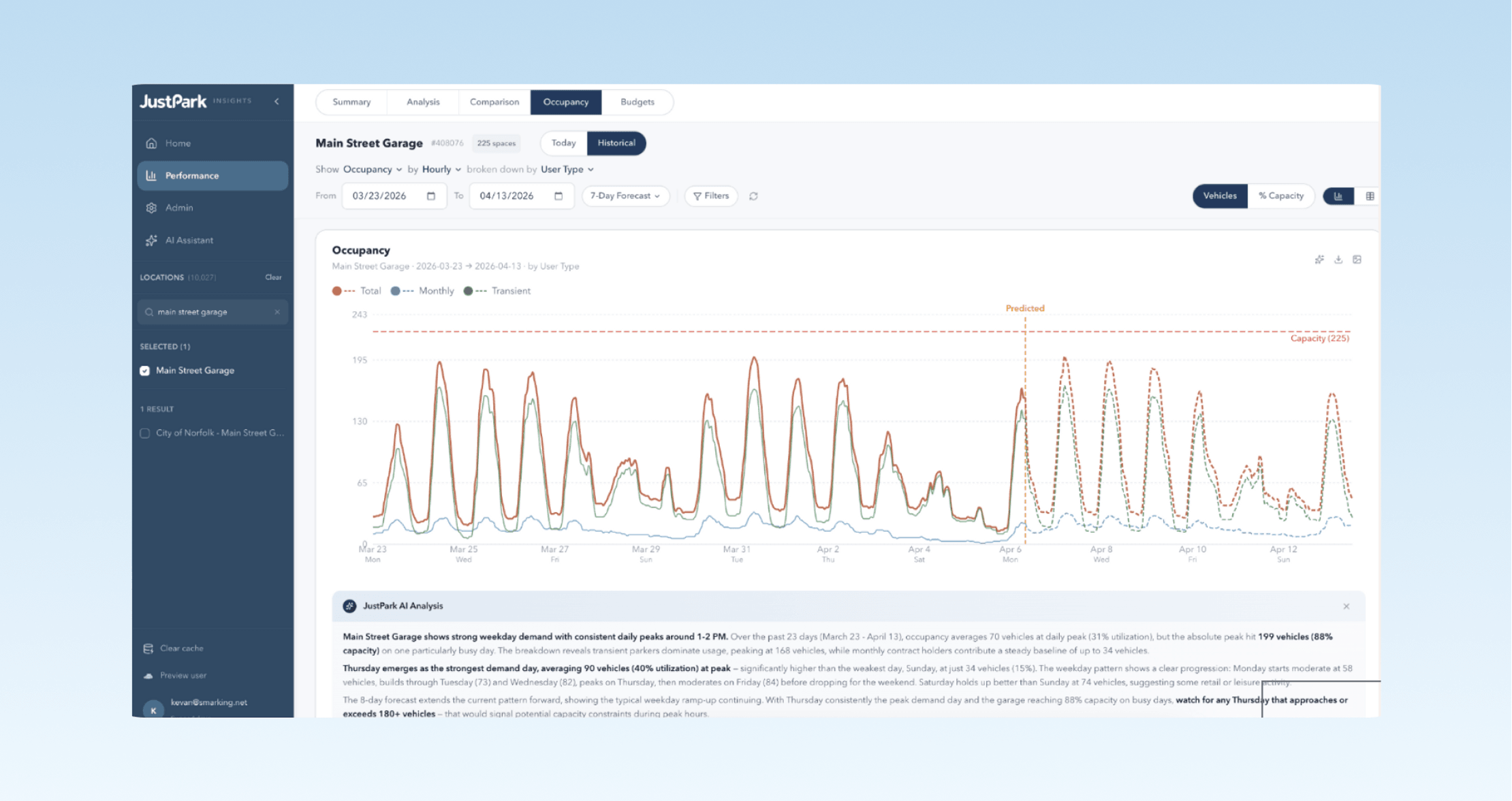
Where AI helps today: JustPark Insights includes predictive models for occupancy, transactions, and revenue. On any given day, you can see actual performance through the current hour and a forecast for the rest of the day on the same chart. Toggle a 3-day, 7-day, or 14-day forecast and the charts extend into the future.
Knowing that Saturday is projected to hit 94% occupancy by 2pm changes how you staff, how you price, and whether you open overflow. That is the difference between reacting and planning.
Prediction works best with deep history. It degrades with thin data and lack of context. AI sees patterns humans miss, but it does not know about the concert that just got announced or the construction project that is about to close your main entrance. Your team’s knowledge and expertise are still primary; BI+AI is their tool.
Level 4: Prescriptive: “What should we do about it?”
Prescriptive BI goes beyond telling you what happened or what will happen. It recommends what to do.
We discussed four use cases in the webinar:
Labor forecasting. “Next Tuesday’s game is against a poor-performing team and has 40% fewer reservations sold at this point than a typical Tuesday night. It’s likely a light crowd. Consider staffing two fewer attendants in Lots A and B.”
Pricing. “Your garage is forecast to be at capacity Tuesday through Thursday from 11am to 3pm. Consider raising online reservations by $4.00 for parkers entering before 3pm.”
Revenue optimization. “Tenant X is underutilizing their allocation by 40%. Recommend reducing reserved spaces from 50 to 30 and releasing the rest to transient. Estimated revenue uplift: $3,200 per month.”
Oversell analysis. “You can safely sell 8% more spaces for prepaid reservations based on historical no-show patterns. Here’s the confidence level.”
These capabilities exist in the JustPark Insights beta today through specialized AI agents. The Price Recommendations agent analyzes pricing elasticity, competitive positioning, and demand patterns. The Tenant Oversell agent calculates optimal oversell ratios by analyzing actual occupancy against contracted spaces. The ROI Calculator models the revenue impact of operational changes using your historical data as the baseline.
The caveat we shared in the webinar: prescriptive AI really depends on knowing your operations. Without that context, prescriptions risk being generic or flat-out wrong. This is why location profiles, user annotations, and human review are built into the workflow.
Level 5: Autonomous: “What can I assign to my system to execute on its own?”
Everything in Levels 1 through 4 still requires a person to initiate the process. You open the platform, click a button, ask a question. Level 5 flips that. The system initiates. It runs on a schedule or a trigger, does the work, and delivers the result.
In the webinar, we briefly introduced the building blocks of AI agents, then we previewed a couple agents we are building into JustPark Insights:
Analyst Briefer: Writes your Monday morning portfolio summary. Not a template with blanks filled in. An actual assessment of what happened last week, which locations underperformed, why, and what to do about it. Delivered automatically.
Anomaly Detective: Scans every location overnight. Revenue drops, occupancy spikes, rate mismatches, validation leakage. Flagged and explained before your team starts the day.
Dynamic Pricer: Adjusts rates within guardrails you define (price floors, ceilings, percentage bands), triggered by occupancy thresholds or schedule. Logs every change and reports what it did.
These agents are early but moving fast. The advances in AI models over just the last three months have made automation in business intelligence possible in ways that were not realistic six months ago. We expect this to be the fastest-evolving area of the product.
Your Platform, Your Way
Beyond the five-level framework, we have rebuilt the JustPark Insights experience from the ground up based on customer needs. But we are not finished with it. We are opening up our Beta version of this new version more broadly to capture feedback and needs from customers.
If you manage parking and you want analytics that think with you instead of just displaying numbers, we would love to show you what we have built. If you are already a JustPark Insights customer, we invite you to try the Beta, where you will be a key voice in how we evolve it.
Want to hear more? Watch the full webinar:
If you're interested in running through a demo of JustPark Insights, fill out the form below.